Naoya Takahashi, M.D
Saiseikai Izuo Hospital, Osaka
Deputy Chief, Department of Cardiology
I had been told that he was “a man who loves catheters.”
A catheter, as far as I knew, was a thin tube inserted into blood vessels. What could it mean to love such a thing?
You cannot exactly go out and buy one yourself, so I did only minimal research before going to meet him. Listening to him—and watching the way he spoke—I began to understand.
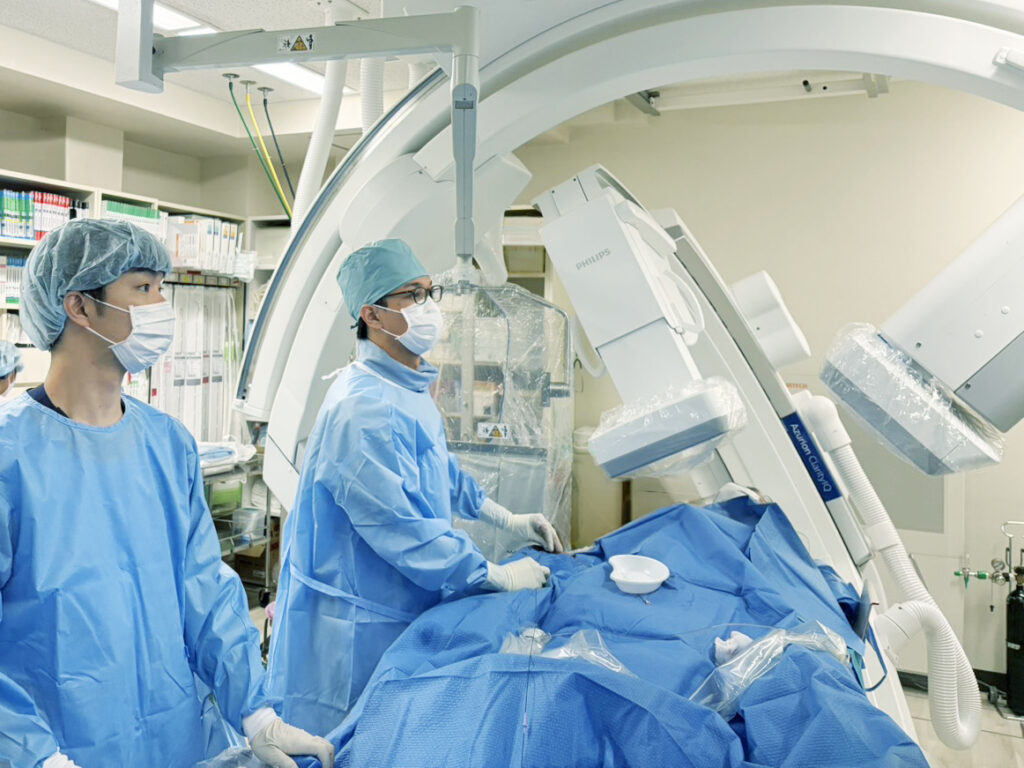
A patient with a blocked coronary artery.
A life entrusted to him.
He threads a catheter from the groin toward the blockage.
As it advances, multiple options are narrowed down in an instant.
He reaches the site and expands the vessel.
Blood, once obstructed, surges forward again. Success.
Throughout this sequence, his concentration peaks to the limit. A zone—as if he himself becomes pure awareness. Then, the sense of accomplishment that follows.This is something he fully savors, day after day.
Why did you become a doctor?
When I asked, his expression softened, replacing the intensity from moments before. He answered with a hint of embarrassment.
One spring day, near the end of his first year of high school, his grandfather passed away.
“My grandfather used to tell me, ‘You should become a doctor.’ When he died, I just thought, maybe I will. That’s really all it was.”
After graduating from university and becoming a cardiologist, he soon decided he wanted to master catheter-based treatment.
To do so, he moved hospitals in search of as many cases as possible.
He thought constantly about how to improve his technique.
At his new hospital, he worked with almost no days off. He accumulated experience, built knowledge, and learned how to remain composed.
Gradually, unexpected situations no longer unsettled him. In time, what counted as “unexpected” itself began to diminish.
“If you open a blocked artery, that may be enough, technically speaking. But if you take the time to finish the procedure carefully, you can sometimes prevent it from closing again years later. I can’t be satisfied unless I go that far. I always treat my patients as if they were my own family.”
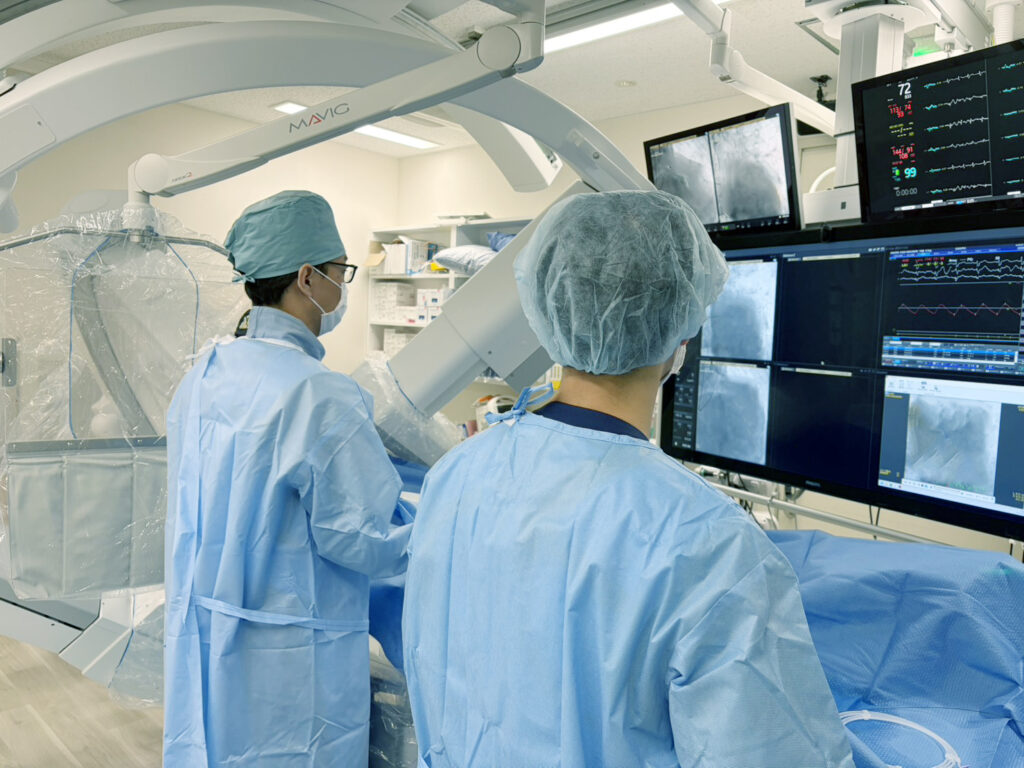
He is so devoted to hands-on practice that he sometimes finds himself unconsciously rehearsing catheter movements in the air.
And yet, he said something unexpected.
“Japan is highly advanced in catheter techniques. I want to systematize that knowledge and spread it globally.”
According to him, catheterization originated in Germany. In Japan, however, distinct techniques and systems have evolved. Many people around the world still lack access to such advanced care. He wants to go to those countries himself and share the methods and expertise developed in Japan, believing this can raise the overall standard of care.
Hearing this, it felt too simplistic to describe him merely as “a man who loves catheters.”
When I said as much, his wife—who had been listening nearby—immediately added:
“But he really does love them. It’s his hobby.”
That, somehow, was reassuring.
By Takeshi Kikkawa